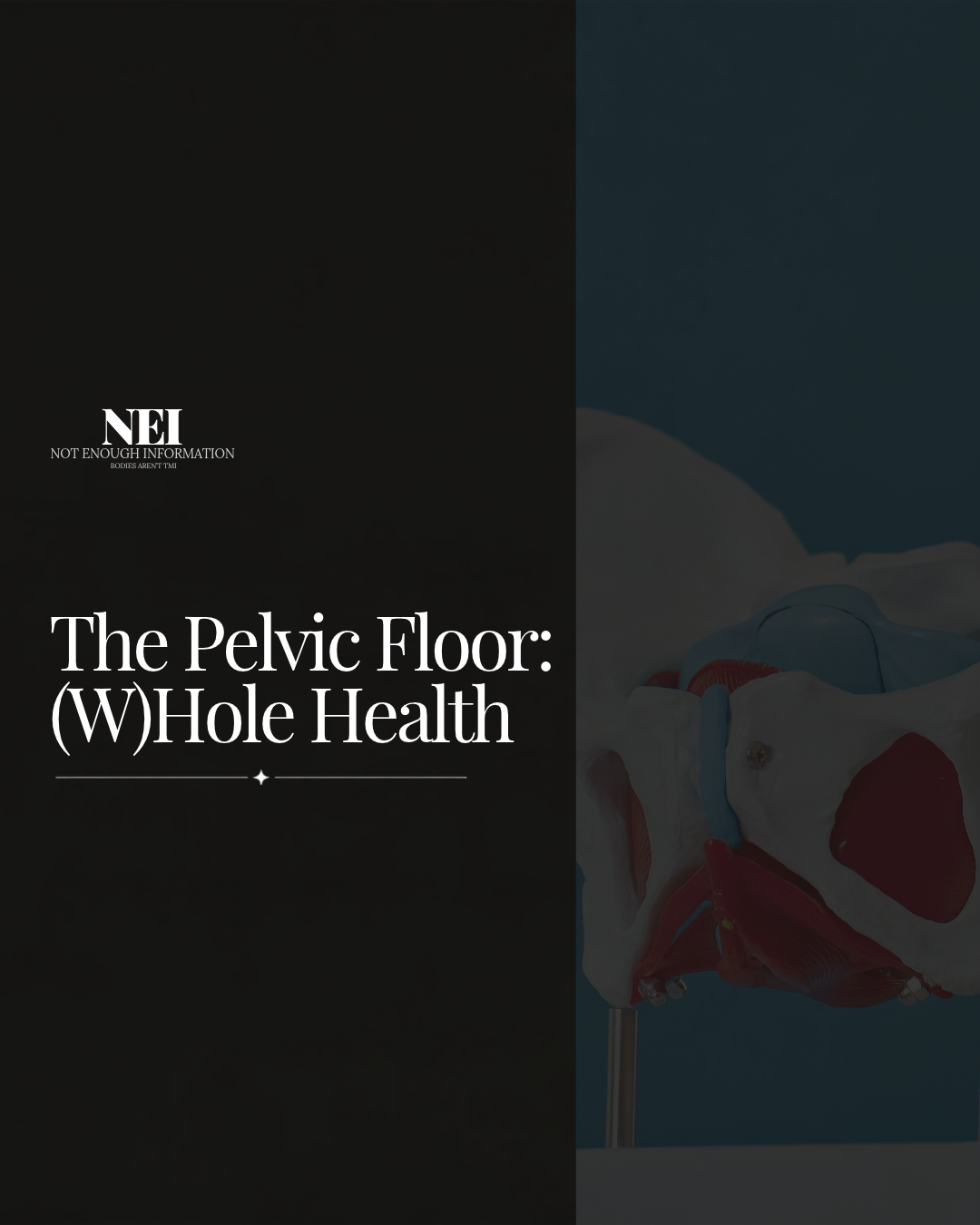
The Pelvic Floor: (W)hole Health — Why People Need More Information
Related Episode
The Pelvic Floor: (W)hole HealthWelcome to Not Enough Information, where we’re flipping the script on what you think you know about your body.
If you’ve ever felt like you were going crazy because your doctor said your bladder looked fine, but you still feel like you have a UTI. Or you’ve experienced pain during sex that seemed unrelated to your digestive issues. Or you’ve dealt with years of recurring UTIs, followed by painful intercourse, followed by back pain—and no one could connect the dots. Well, you’re not alone. And more importantly, you’re not crazy.
Everyone always says TMI, but the real problem is that you don’t have enough. Thats why we’re here💁🏻♀️
Meet Your Pelvic Floor: It’s All About the Holes
Let’s start with the basics, because honestly, most people don’t even know what their pelvic floor is, let alone what it does.
Your pelvic floor is a group of muscles—think of it like a bowl or hammock—that sits inside your pelvis. And here’s the key thing that makes understanding it so much easier: it’s all about the holes.
If you have a penis, there are two holes that pass through your pelvic floor:
- The urethra (where pee and ejaculate come out)
- The anus (where poop comes out, and where other things might go in)
If you have a vulva and vagina, there are three holes:
- The urethra
- The anus
- The vagina
This simple framework—thinking about the holes—is actually revolutionary for understanding pelvic floor health. Because here’s the thing: anything that has to do with those holes has to do with your pelvic floor. Anything.
Why You Can’t See Them (But You Should Know About Them)
One reason so many people lack information about their pelvic floor is obvious: you can’t see these muscles. They’re internal. They’re hidden. Out of sight, out of mind, right?
But these muscles are doing a lot of work.
Your pelvic floor muscles are:
- Supporting your organs: Your bladder, rectum, and either your prostate or uterus are all held up by these muscles. They’re working 24/7 to keep everything in place.
- Moving with your breathing: Your pelvic floor muscles work in tandem with your diaphragm. Every time you breathe, these muscles are moving. This is why they’re crucial for core stability and why you’re upright instead of, well, a jellyfish.
- Involved in sexual function: These muscles wrap around the vaginal opening or the base of the penis, and they’re essential for pleasurable sex.
- Controlling elimination: They help you control when and where you pee and poop.
When you start to understand all the things your pelvic floor does, it becomes a lot less surprising that pelvic floor therapists see pregnant people, people with bladder issues, people with bowel problems, people with sexual dysfunction, and people with back and hip pain. These muscles are connected to all of it.
The Interconnectedness Problem: Why Your Symptoms Aren’t Separate
Here’s where things get really interesting—and where a lot of people start to feel less crazy.
Let’s say you had a UTI. Maybe a bad one. You took antibiotics, and it cleared up. But then you started getting UTIs all the time. Sometimes they test positive for bacteria, sometimes they don’t. Around the same time, you noticed that penetrative sex became painful. Or maybe you couldn’t even insert a tampon without discomfort.
To you, these feel like two separate problems. But to a pelvic floor specialist? Of course they’re connected. The urethra sits right on top of the vagina. The muscles surrounding both are literally neighbors. If those muscles go into spasm—which can absolutely happen after a bad infection, stress, or repeated antibiotic use—of course you’re going to have symptoms in both areas.
This is one of the most important insights from the pelvic floor perspective: symptoms are interconnected because the muscles are interconnected.
Think about it this way. You have one group of muscles wrapping around the urethra, the vaginal opening, and the anus. If one area starts to guard or tense up, the whole system gets pulled in. It’s like pulling one string on a hammock—the whole thing shifts.
This is why pelvic floor therapists often see patients with multiple, seemingly unrelated symptoms:
- Bladder urgency + painful sex
- Constipation + lower back pain
- Recurring UTIs + hip pain + pelvic pain
- Difficulty with penetration + groin pain + digestive issues
When patients finally understand this interconnectedness, something clicks. They realize they’re not going crazy. Their body isn’t broken. Their symptoms actually make sense when you understand the anatomy.
The Snowball Effect: Why Early Information Matters
Here’s what often happens when people don’t have enough information about their pelvic floor:
A person experiences symptoms. They see a doctor who specializes in one area—say, urology—and that doctor looks at the bladder. The bladder looks fine. So the doctor might dismiss the symptoms, or prescribe antibiotics just in case.
The symptoms persist. So the patient gets stronger antibiotics, or a different type, or another round. Maybe this happens three, four, or five times.
Meanwhile, the pelvic floor muscles are getting more and more tense because the person is stressed and scared. The repeated antibiotics are wreaking havoc on their gut. The muscles are guarding even more in response. And now new symptoms start to appear—pain with sex, difficulty inserting tampons, pain with tight clothing, pain all the time.
What started as one symptom has snowballed into multiple interconnected problems, all rooted in the same place: the pelvic floor.
This is why pelvic floor education matters so much. Early, accurate information can prevent this cascade.
Beyond the Obvious: Hip, Back, and Groin Pain
Here’s something that might surprise you: your pelvic floor can be connected to pain you experience nowhere near your pelvis.
Pelvic floor therapists frequently see patients with a history of hip pain, back pain, or groin pain who never connected these symptoms to their bladder, bowel, or sexual dysfunction. But when you understand that pelvic floor muscles attach to the pubic bone and work in coordination with your hip and core muscles, it makes sense.
Sometimes, when a pelvic floor therapist palpates (feels) a hip muscle internally during an examination, a patient will have a lightbulb moment: “That’s my back pain!”
Yep. Because those muscles have a big role in supporting your whole system.
The Bottom Line: It’s All Connected
The pelvic floor isn’t a niche topic for pregnancy or sexual dysfunction. It’s fundamental to how your body works. It affects your ability to pee, poop, have sex, move without pain, and maintain core stability.
And here’s the thing: most people don’t have enough information about it.
So if you’ve ever felt like your symptoms don’t make sense, or like different doctors are treating you for different unrelated problems, or like you’re going crazy because your body isn’t responding to treatment—this episode is for you.
Because you’re not going crazy. Your pelvic floor is just trying to tell you something.
Ready to dive deeper? Listen to the full first episode of Not Enough Information to hear Dr. Rachel Gelman and Dr. Britt Van Hees break down pelvic floor anatomy, discuss the interconnectedness of symptoms, and explore why holistic pelvic health matters. Because when it comes to your body, there’s definitely no such thing as TMI—only not enough information.